Locks, and the habit that matters more
A good lock badly used protects nothing. Most stolen bikes were locked — just not well.
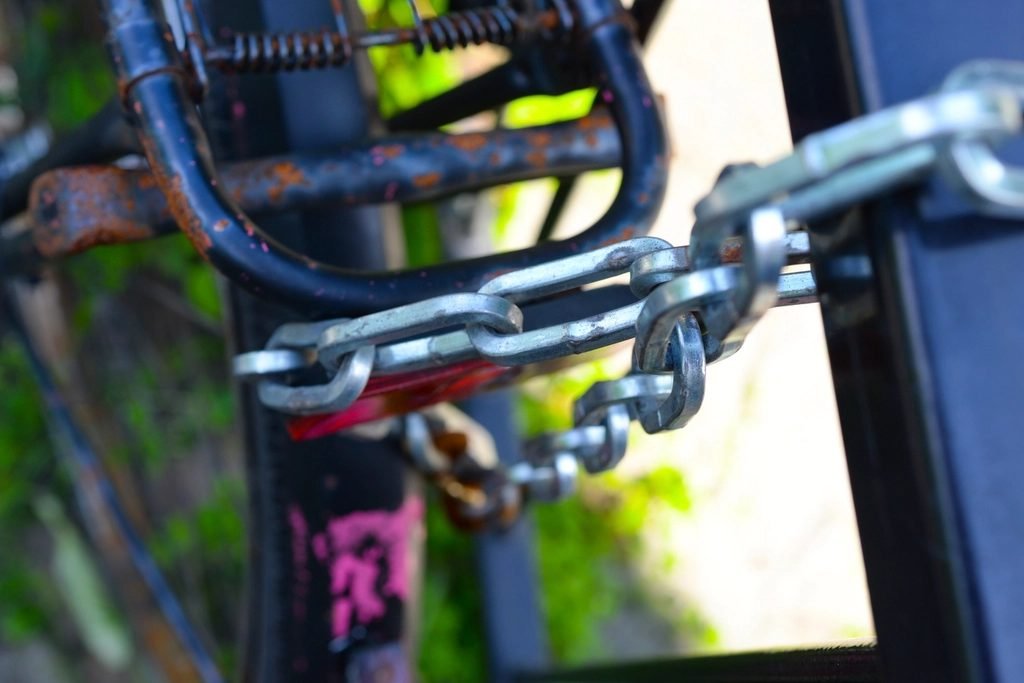
What I actually do
A habit that sits in front of the lock, not behind it.
I do not leave it outside
Everything below is about choosing and using a lock. This is about the habit that decides how much work the lock has to do in the first place.
- I do not lock my bike up outside and walk away from it. If I stop, the bike either comes with me or stays somewhere I can see it from where I am sitting.
- That is my own habit rather than a claim about any particular town. It is simply the approach I trust, and it costs me nothing.
- A lock buys time against someone working unobserved. Staying where I can see the bike removes the conditions they need, which is a different kind of protection than a security rating.
If your routine genuinely requires leaving a bike unattended for hours, the lock guidance below matters far more than my habit does. If you can arrange not to, that is the stronger option every time.
Bike theft is mostly opportunistic. A thief walking a street is comparing targets, and their decision comes down to how long your bike would take, how much noise it would make, and whether anyone would notice. Everything below is about losing that comparison.
Lock types, honestly assessed
| Type | Real-world security | Weight | Best for |
|---|---|---|---|
| Cable lock | Almost none — cut in seconds | Very light | Securing a wheel to the frame, nothing more |
| Folding lock | Moderate | Light | Short stops in lower-risk areas |
| U-lock / D-lock | High | Moderate | The default choice for most people |
| Heavy chain | Very high | Heavy | Overnight or long stays in high-risk areas |
| Two locks of different types | Highest | Heaviest | Expensive bikes, city centres |
A cable lock is not a lock. A cheap pair of hand cutters goes through one almost silently in a few seconds. Use one to secure a wheel to your frame if you like, but never as the thing holding your bike to the world.
How much should you spend?
The common guidance is around 10% of the bike’s value, and it is a reasonable starting point — but risk matters more than price. A modest bike locked overnight on a city street needs more lock than an expensive one locked for ten minutes outside a village shop.
Look for an independent security rating rather than the manufacturer’s own marketing number. Different countries use different schemes — Sold Secure in the UK and ART in the Netherlands are two well-established ones. A rated lock has been attacked by testers with real tools for a set period. An unrated lock has been tested by nobody.
Insurers often require a specific rating for a claim to be valid, and will ask for the receipt and the lock itself. If you insure the bike, buy the rating your policy names — not the one above or below it.
Locking properly: the part that matters
Most bikes are stolen not because the lock failed, but because of how it was used. The principles are simple and they matter more than the money you spent.
Lock the frame, not just a wheel
A wheel comes off in seconds. The lock must pass through the main triangle of the frame, and ideally through the rear wheel at the same time — the rear triangle is a natural place to catch both.
Attach it to something immovable
A proper bike stand, ideally. Check what you are locking to: signposts can be lifted off, railings can be loose, and a small tree can be cut faster than your lock.
Fill the space inside the shackle
Empty space inside a U-lock gives room for a lever or jack. Choose a lock size that fits your bike snugly rather than the largest one available.
Keep the lock off the ground
A lock resting on the pavement can be smashed against it with a hammer. Locking at frame height removes that leverage.
Turn the keyhole downwards
It makes picking and drilling more awkward, and keeps rain out of the mechanism, which is why locks seize in winter.
Where you lock is as important as how
- Busy, overlooked places beat quiet ones — thieves dislike audiences
- Cover by CCTV genuinely helps, both as deterrent and afterwards
- Avoid locking in the same spot at the same time every day; patterns get noticed
- Inside a locked building beats any outdoor spot, always
- If a rack is already full of bikes, yours only has to be less appealing than the others
What to do before anything happens
Ten minutes now is what makes recovery possible later. Without these, a found bike cannot be proved to be yours and will not be returned.
- Photograph the bike — whole bike from both sides, plus close-ups of any distinctive marks or damage
- Record the frame number — usually stamped under the bottom bracket, sometimes on the head tube or rear dropout
- Register it — most countries have a national database; registration links the frame number to you and is what police check
- Keep the receipt — for insurance, and as proof of ownership
- Check your insurance — some home contents policies cover bikes away from home, many do not
If it does get stolen
Act quickly, in this order:
Report it to the police
Do this even if you expect nothing to come of it. Without a crime reference number there is no insurance claim and no way for police to return a recovered bike.
Mark it stolen on the registration database
This is what flags the frame number if the bike is checked or offered for resale.
Search local resale listings
Stolen bikes commonly appear within days on marketplace sites and in nearby towns. Search by model, and by frame description rather than exact wording.
Never confront a seller yourself
If you find your bike, take a screenshot with the listing URL and give it to the police. Arranging to meet a thief alone is how people get hurt.
Buying a replacement second-hand? The choosing a bike guide has a twelve-point checklist for used bikes, including checking the frame number against a stolen-bike register before you hand over money.
Three things that matter most
Rated lock, frame and rear wheel
An independently rated U-lock through the frame and rear wheel, attached to a proper stand, defeats the overwhelming majority of attempts.
Photos and frame number today
Recovery is impossible without proof the bike is yours. This takes ten minutes and you only have to do it once.
Lock where people are
Thieves choose targets by risk of being seen. A busy, overlooked rack is worth more than an extra lock.
Questions people ask about bike security
For most riders in most places, one properly rated U-lock used correctly is enough. Two locks of different types is the serious upgrade, because it forces a thief to carry and use two different tools.
A heavy, hardened chain is extremely secure but heavy enough that most people leave it at home — which protects nothing. A U-lock you actually carry beats a chain you do not.
Yes. Sheds and garages are common targets and are often less overlooked than the street. Lock the bike to something fixed inside the building rather than relying on the door.
If it is quick-release and you are leaving the bike for a long time, taking it or locking it to the frame is sensible. A cable through the front wheel back to the main lock is a reasonable compromise.
They can help recovery, but they are not a deterrent and they do not prevent theft. Treat one as a supplement to a good lock, never a substitute for it.
There is something to it. Scuffed paint, mismatched parts and old-looking tape make a bike less attractive to resell, and plenty of riders do this deliberately. It is not a substitute for locking properly.
Related guides
Three more that pair naturally with this one.
Cycling in Morocco
Roads, drivers, water, heat and shops – what riding here is actually like.
Buying a replacement?
The buying guide covers the twelve checks worth making on any second-hand bike, including the stolen-bike check.